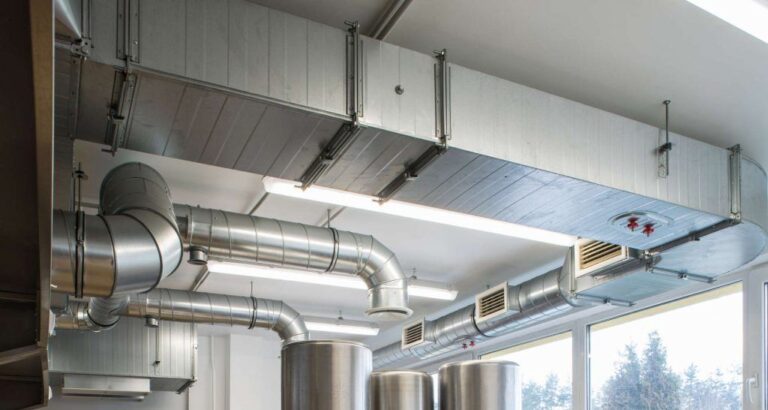

High Pressure Ductwork Solutions for Commercial and Industrial Applications
At Apollo Heating & Cooling, we have been providing expert HVAC solutions since 1981 as a locally owned and operated company serving St. Clair Shores, MI and the surrounding communities of Warren, Roseville, Eastpointe, and Harper Woods. High pressure ductwork represents one of the most critical and technically demanding areas of HVAC installation and service, requiring precision engineering, specialized materials, and deep industry knowledge. Our dedication to giving every customer a one-on-one personal experience extends to even the most complex ductwork projects, where attention to detail directly impacts system performance, energy efficiency, and long-term reliability.
High pressure ductwork systems operate at static pressures typically ranging from 3 inches of water gauge up to 10 inches of water gauge, distinguishing them from standard low-pressure residential systems that usually operate below 2 inches. These elevated pressures demand reinforced construction, tighter sealing standards, and more rigorous installation practices. When designed and installed correctly, high pressure ductwork delivers conditioned air over longer distances and through more complex building layouts than conventional systems can accommodate.
Understanding High Pressure Ductwork Design and Engineering
The design of high pressure ductwork begins with a thorough analysis of building requirements, including total airflow volume, the distance air must travel, the number of zones or terminal units being served, and the specific pressure drop characteristics of each component in the system. Engineers calculate friction losses through straight runs, fittings, transitions, and dampers to determine the total external static pressure the air handling unit must overcome. Every elbow, tee, and reduction contributes to the cumulative pressure loss, making careful design essential to system efficiency.
High pressure duct systems commonly use the static regain method or equal friction method for sizing. The static regain method adjusts duct dimensions at each branch takeoff to maintain consistent static pressure throughout the system, which promotes balanced airflow distribution without excessive manual balancing. This approach is particularly valuable in large commercial buildings where dozens of variable air volume boxes must receive adequate pressure to function within their designed operating range. At Apollo Heating & Cooling, our goal is 100% customer satisfaction, and that starts with getting the engineering right before any metal is fabricated or installed.
Materials and Construction Standards
High pressure ductwork requires heavier gauge sheet metal than standard systems. While residential ductwork might use 26-gauge or 28-gauge galvanized steel, high pressure applications typically call for 22-gauge, 20-gauge, or even 18-gauge material depending on the duct dimensions and operating pressure class. The Sheet Metal and Air Conditioning Contractors National Association, known as SMACNA, publishes detailed construction standards that specify reinforcement intervals, joint types, and sealing requirements for each pressure classification.
Key material and construction considerations include the following:
- Gauge thickness selection must correspond to both the duct dimensions and the pressure class to prevent deflection, oil canning, and structural failure under operating conditions
- Transverse joint construction requires companion angle flanges, welded flanges, or other rigid connection methods that maintain integrity under sustained positive pressure
- Sealing requirements escalate significantly at higher pressure classes, with SMACNA Seal Class A mandating that all transverse joints, longitudinal seams, and duct wall penetrations be sealed with approved mastic or gasket materials
- Reinforcement spacing decreases as pressure increases, with intermediate structural supports added at calculated intervals to prevent duct walls from bowing outward
- Hanger and support systems must account for the additional weight of heavier gauge materials and the outward forces generated by internal pressure
Applications Across Commercial and Industrial Settings
High pressure ductwork serves a wide range of building types and applications throughout the Michigan region and beyond. Large office complexes frequently rely on high pressure trunk ducts to distribute air from central air handling units to variable air volume terminal units located throughout multiple floors. Hospitals and healthcare facilities use high pressure systems to maintain the precise air pressure relationships required between clean rooms, operating suites, isolation rooms, and general patient areas. Manufacturing facilities depend on high pressure ductwork to deliver process air, maintain clean room classifications, or supply ventilation air across expansive production floors.
Retail environments, educational institutions, and multi-story mixed-use buildings also benefit from high pressure duct designs. In these applications, a central mechanical room houses large capacity air handlers that push conditioned air through high pressure mains to remote areas of the building. The high velocity air traveling through these ducts allows for smaller duct cross-sections compared to low-pressure alternatives, which saves valuable ceiling plenum space and reduces construction costs associated with larger structural cavities.
Testing, Balancing, and Quality Assurance
Once high pressure ductwork is installed, rigorous testing ensures the system meets design specifications and leakage standards. Pressure testing involves temporarily sealing all openings and pressurizing the duct system to its rated operating pressure while measuring air leakage. SMACNA leakage classifications define acceptable leakage rates based on the duct surface area and pressure class. Industry data suggests that poorly sealed ductwork can lose 20 to 30 percent of conditioned air before it reaches occupied spaces, translating directly into wasted energy and increased utility costs.
Air balancing follows pressure testing and involves measuring airflow at each terminal device, adjusting dampers, and verifying that every zone receives the volume of air specified in the design documents. This process is critical because even well-designed systems can deliver uneven airflow if installation tolerances are not maintained or if field modifications were made without engineering review.
Maintenance and Long-Term Performance
Maintaining high pressure ductwork systems requires periodic inspection of joints, seals, and structural reinforcements. The higher operating pressures accelerate wear on gaskets and sealants over time, and even small breaches can result in significant energy losses and noise issues. Vibration from high velocity airflow can loosen mechanical fasteners and compromise joint integrity if not monitored regularly.
Recommended maintenance practices include:
- Annual visual inspections of accessible duct sections to identify signs of sealant degradation, corrosion, or physical damage from adjacent construction activities
- Periodic leakage retesting especially after any modifications, renovations, or additions to the duct system
- Filter replacement and coil cleaning on associated air handling equipment to prevent excessive static pressure buildup that could push the ductwork beyond its rated capacity
Why Choose Us for Your High Pressure Ductwork Needs
Serving the communities of St. Clair Shores, Warren, Roseville, Eastpointe, and Harper Woods since 1981, Apollo Heating & Cooling brings decades of hands-on experience to every high pressure ductwork project. We understand that these systems demand precision at every stage, from initial design calculations through fabrication, installation, testing, and ongoing maintenance. Our commitment to providing a personal, one-on-one experience means that you work directly with knowledgeable professionals who understand your specific building requirements and performance expectations. When you need high pressure ductwork that performs reliably for years to come, trust the local expertise that has been dedicated to this community for over four decades.